
In this guide
Income tax tops out at 20 per cent, residents are far more likely than people in the UK to say they feel very safe, and in 2025 more than half of adults were on a beach at least once a week. Against that, homes cost more than London's on the latest official comparison, newcomers can rent only a small part of the market and pay full GP fees for six months, and average pay has slipped slightly in real terms over ten years. Of the people who moved here in 2017, 43 per cent were still here five years later.
Most answers to "is Jersey a good place to live?" are one person's experience. This page uses official figures instead, from Statistics Jersey, the Government and the competition regulator. Whether the pros win comes down mostly to your housing status and your income.
The short version
| Pros | Cons |
|---|---|
| Income tax capped at 20 per cent; no capital gains or inheritance tax | The average home costs more than in London |
| Residents feel much safer than people in the UK | The housing law limits newcomers to a small rental market |
| Beaches and countryside within minutes | Full GP fees and limited hospital cover at first |
| Short journeys: nearly three in ten walk to work | Groceries and everyday costs above UK prices |
| Free States schools and low-fee States colleges | Weather can cancel flights and sailings |
| Pay above the UK median | Real pay has drifted down over ten years; the population is ageing |
The pros
Tax
In 2026 income tax is 20 per cent at most, with no higher bands. Lower earners pay less under marginal relief, 26 per cent of income above a £21,250 threshold. Employees add 6 per cent social security on earnings up to £72,744 a year and a long-term care contribution of up to 1.5 per cent. There is no capital gains tax and no inheritance tax. On a salary of £100,000 a single person keeps £74,135 a year under the 2026 rules. See our tax guide and Jersey vs London comparison.
Safety
Statistics Jersey's Opinions and Lifestyle Survey (published December 2025) found that the share of adults who feel "very safe" in everyday settings was on average about 25 percentage points higher than in the UK for men and 20 points higher for women. Women feel less safe than men: 49 per cent of men strongly agreed that Jersey is a safe place for everyone, against 28 per cent of women.
The outdoors
The island covers 45 square miles, 14 miles from France and 85 from England. In the 2025 survey, 54 per cent of adults visited a beach at least once a week, 32 per cent visited coastal or inland paths weekly, and 68 per cent said access to Jersey's natural environment was very important to them.
Short journeys
Statistics Jersey's latest travel-to-work figures, for 2019, found that 29 per cent of workers walked to work and 5 per cent cycled, leaving 53 per cent going by car (excluding those working from home). Our where to live guide covers each parish.
Schools
States primary and secondary schools are free, and the fee-paying States colleges are cheap by UK standards: Jersey College for Girls charges £2,920 a term for 2026 to 2027. See our schools guide.
The cons
Housing costs
Statistics Jersey's mean prices for Q2 2026 were £326,000 for a one-bed flat, £580,000 for a two-bed flat and £797,000 for a three-bed house. The latest official comparison, for Q1 2024, put Jersey's average at £599,000 against £505,000 for London and £281,000 for the UK. In 2025, a working household on average net income could afford a mortgage on the median-priced one-bed flat, but not on a two-bed flat or a house of any size. Renting is no escape: gov.je put the average advertised one-bed flat at about £1,300 a month in the Qualified market and £1,400 in the Registered market in Q3 2025.
Housing status rules
Arrive without a sponsoring employer and the housing law gives you Standard status: you can rent one Registered property only. You reach Entitled for Work Only after five years' residence and full Entitled status, with the right to buy anywhere, after ten. A job can short-cut this: under guidance published in November 2025, a full-time role paying at least £54,000 can bring a Licensed permission to rent Qualified homes, and £60,000 or more to rent or buy. Statistics Jersey's housing needs report (July 2026) found that, before any new building, the non-qualified sector roughly balances overall for 2026 to 2028 but is 420 one-bedroom homes short. See housing qualifications and renting in Jersey.
Healthcare and the safety net
Jersey is not in the NHS. In December 2025 a GP appointment cost £33.86 on average after the Government subsidy, but people here less than six months pay the full cost, with advertised visitor prices of £85 to £100. Hospital care beyond the Emergency Department is free only after six months' residence while paying social security or income tax, or twelve months if you are not working, unless you hold Licensed status. Income Support typically needs five years' continuous residence. Our healthcare guide explains the rules.
Wages against prices
Pay is higher than in the UK. Median full-time earnings were £930 a week in June 2026, against £811.20 for UK full-time employees in April 2026; the two are measured differently, so treat the gap of about 15 per cent as a rough guide. House prices, though, are more than twice the UK average, and average earnings fell 0.8 per cent in real terms over the ten years to June 2026. In the 2025 lifestyle survey, 30 per cent of households found it difficult to cope financially and 33 per cent could not afford an unexpected but necessary expense of £1,400. UK adults reported higher life satisfaction than Jersey adults, with the bigger gap among women.
Small-island life and travel
An estimated 104,490 people lived here at the end of 2025. That means a strong community, and also that everyone knows your business. Travel depends on the weather: Ports of Jersey reported 2.9 per cent of arriving flights cancelled in January to March 2026, against 0.7 per cent in July to September 2025, though it does not break cancellations down by cause; high winds also cancelled a number of sailings in late August and September 2025. Our cost of living guide budgets £150 a month for a couple's two trips home a year.
An ageing population
Between 2020 and 2025 the number of residents aged 65 and over rose 13 per cent while under-16s fell 7 per cent. In 2025 there were 910 deaths and 710 births. Statistics Jersey's February 2026 projections show that, with net migration of about 400 a year, the working-age population would shrink from 68,530 in 2024 to 62,770 in 2050; holding it steady would take net migration of about 700 a year. The dependency ratio, non-working-age people per 100 of working age, rose from 48.7 in 2015 to 53.5 in 2025.
Why is Jersey so expensive?
Official data points to four reasons.
- Land and housing. About 104,490 people share 45 square miles, roughly 2,300 per square mile, and house prices have risen faster than both earnings and retail prices since 1997, according to Statistics Jersey.
- Freight and labour. The Jersey Competition Regulatory Authority's groceries market study found in June 2023 that the same basket was about 12 per cent cheaper at the same retailer in the UK, and the cheapest UK grocers were up to about 33 per cent cheaper than Jersey's shops. Its final report (September 2023) blamed higher on-island operating costs, mainly freight and labour, and tax differences, not a lack of competition.
- Tax on food. Goods and Services Tax at 5 per cent applies to almost everything; gov.je does not list food among the zero-rated or exempt supplies.
- Not current inflation. Prices are not currently rising faster than the UK's: Jersey's Retail Prices Index rose 3.0 per cent in the year to September 2026, 0.6 points below UK CPIH at 3.6 per cent.
Why are people leaving Jersey?
Official statistics count who leaves, not why.
The overall flow is roughly balanced. In 2025 about 3,620 people moved to Jersey and about 3,430 left, net migration of about +180 (figures rounded). With 200 more deaths than births, the population was almost unchanged at 104,490.
Long-term residents are the ones leaving. More adults with Entitled status left than arrived in every year from 2017 to 2024, while Registered (now Standard) and Licensed arrivals kept totals up.
| Net migration, adults 20 and over | Entitled | Registered (now Standard) | Licensed |
|---|---|---|---|
| 2021 | -990 | +550 | +200 |
| 2022 | -970 | +970 | +340 |
| 2023 | -670 | +870 | +420 |
| 2024 | -810 | +960 | +340 |
The 2025 estimates continue the pattern: about -770 Entitled, +480 Registered and +300 Licensed.
Many newcomers do not stay. Of the roughly 4,390 people who moved to Jersey in 2017, 28 per cent had left within a year and 43 per cent were still resident five years later (Statistics Jersey, January 2025). Retention was lowest for people on Registered status (32 per cent), for 16 to 29 year olds (33 per cent), and for Polish and other European nationals (22 and 27 per cent), against 52 per cent for Jersey or British nationals. Of those who started in low-earning industries such as hospitality and retail, 35 per cent stayed five years, against 54 per cent in high-earning industries.
The report does not claim that low pay makes people leave. It suggests that the number and type of work permits, and residential and housing status rules, may play a part. That fits the housing costs and financial pressures above, but no official survey asks leavers why.
Who Jersey suits
- It suits people arriving with a Licensed role, higher earners, and families who value safety, beaches and free or low-fee schools.
- It is harder for low-paid newcomers on Standard status, people who must travel often or at short notice, and anyone who might need state support in their first five years.
Check what status you would have first, then run your numbers with our guide to how much money you need to live in Jersey.
Frequently asked questions
Is Jersey a good place to live?
For many people, yes: low tax, pay above UK levels, safety, beaches and short commutes. It works best with Licensed or Entitled status and a good salary; on Standard status and a modest income, housing makes it hard going.
What are the pros and cons of living in Jersey?
Pros: 20 per cent maximum income tax, no capital gains or inheritance tax, safety, beaches, short commutes and free States schools. Cons: housing dearer than London's, rules restricting newcomers' housing for up to ten years, GP fees, high prices, weather disruption and an ageing population.
Why is Jersey so expensive?
Mainly housing: land is scarce and house prices have outpaced earnings since 1997. The competition regulator found in 2023 that groceries cost more because of freight, labour and tax, not weak competition.
Why are people leaving Jersey?
No official source records reasons. More Entitled adults left than arrived every year from 2017 to 2024, and only 43 per cent of 2017 arrivals were still here five years later; young adults, Registered residents and low-paid workers were least likely to stay.
Is Jersey safe to live in?
Residents think so. In the 2025 Opinions and Lifestyle Survey, the share feeling very safe was about 20 to 25 percentage points higher than in the UK, though women felt less safe than men in every setting.
More guides



Photography in More guides
- La Corbière lighthouse at low tide, St Brelade. Photograph: Daniel Kraft, CC BY-SA 3.0, via Wikimedia Commons
- Liberation Square, St Helier. Photograph: Unukorno, CC BY-SA 4.0, via Wikimedia Commons
- A Condor ferry entering St Helier harbour, before DFDS took over the routes in 2025. Photograph: Tom Brossman, CC0 1.0, via Wikimedia Commons
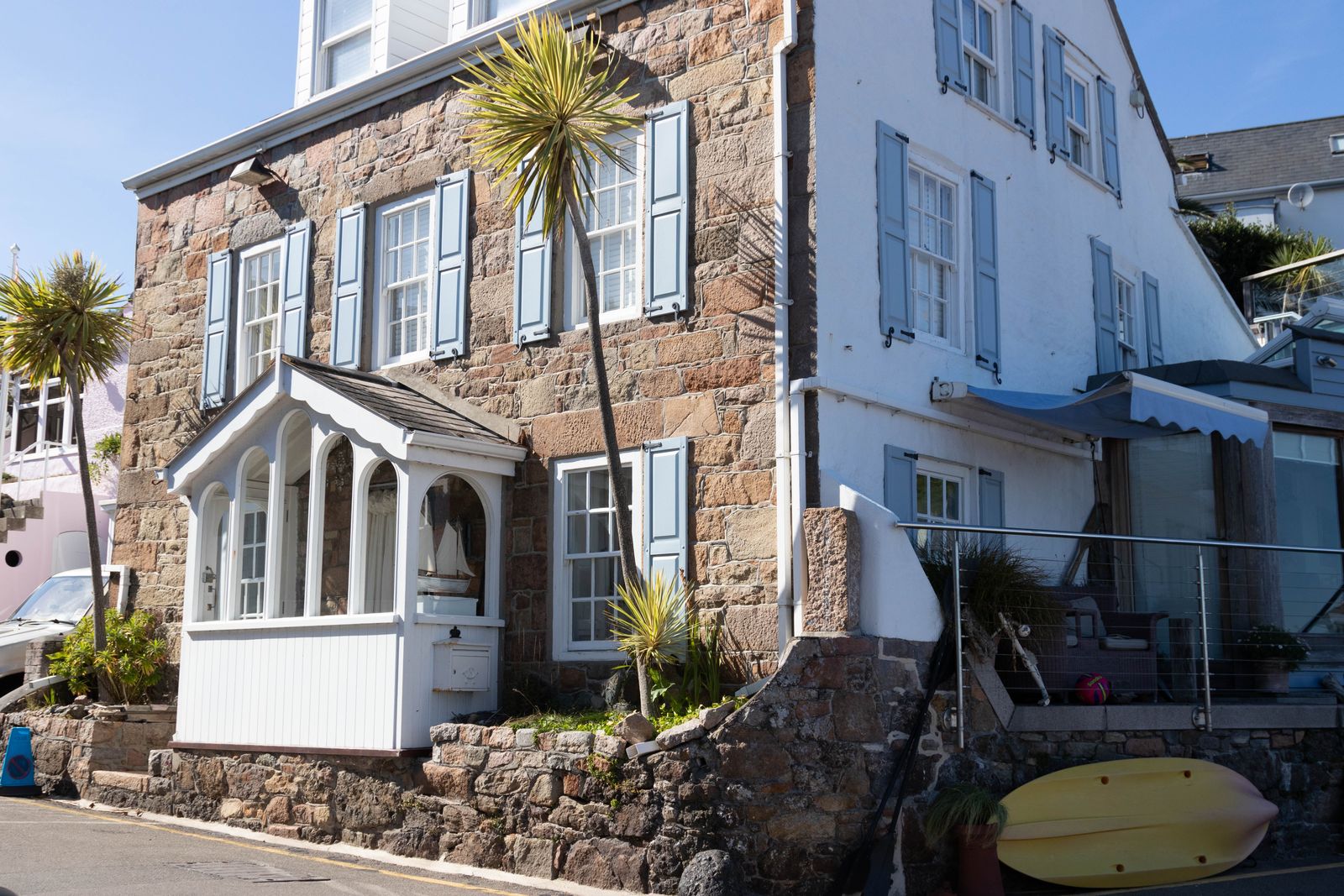
- A granite house at Rozel, St Martin. Photograph: Danrok, CC BY-SA 4.0, via Wikimedia Commons
Sources
- https://gov.je/StatisticsPerformance/HousingLiving/Pages/InternationalComparisons.aspx
- https://stats.je/publication/population-and-migration-2025-total-population/
- https://stats.je/statistic/population/
- https://stats.je/wp-content/uploads/2025/09/R-Population-and-migration-2024-residential-statuses-SJ20250924.pdf
- https://gov.je/SiteCollectionDocuments/Government%20and%20administration/Inward%20migrant%20analysis%20-%202017%20cohort.pdf
- https://www.gov.je/News/2025/Pages/Inward-migrant-analysis-for-2017-cohort-published.aspx
- https://stats.je/publication/jersey-opinions-and-lifestyle-survey-2025/
- https://stats.je/news/latest-population-and-household-projections-for-jersey-published-today/
- https://stats.je/wp-content/uploads/2026/08/R-House-Price-Index-Q2-2026-9GI-SJ20260806.pdf
- https://stats.je/statistic/housing-affordability/
- https://stats.je/publication/future-housing-needs-2026-to-2028/
- https://stats.je/news/average-earnings-index-for-june-2026-and-earnings-statistics-report-published/
- https://www.ons.gov.uk/employmentandlabourmarket/peopleinwork/earningsandworkinghours/bulletins/annualsurveyofhoursandearnings/2026
- https://stats.je/publication/retail-prices-index-september-2026/
- https://www.jcra.je/media/598752/no-immediate-competition-issues-for-jersey-s-grocery-market.pdf
- https://www.jcra.je/media/598832/final-report-published-on-study-of-jersey-s-groceries-market.pdf
- https://www.gov.je/TaxesMoney/GST/Businesses/Introduction/pages/whattaxed.aspx
- https://www.gov.je/TaxesMoney/IncomeTax/Individuals/AllowancesReliefs/Pages/2026TaxAllowances.aspx
- https://www.gov.je/Working/Contributions/Employers/Pages/Tables.aspx
- https://gov.je/Benefits/LongTermCareScheme/Pages/Funding.aspx
- https://www.locatejersey.com/living-working-in-jersey/tax-contributions/
- https://www.gov.je/Working/Contributions/RegistrationCards/Pages/ResidentialStatus.aspx
- https://www.gov.je/News/2025/Pages/ControlsRelaxedForLocalBusinesses.aspx
- https://www.gov.je/LifeEvents/MovingToJersey/LivingInJersey/Pages/AccommodationRestrictions.aspx
- https://www.bailiwickexpress.com/news/in-numbers-how-has-the-cost-of-a-gp-appointment-changed/
- https://www.gov.je/Health/Travelling/Pages/MovingReturning.aspx
- https://www.gov.je/LifeEvents/MovingToJersey/LivingInJersey/pages/benefits.aspx
- https://www.gov.je/StatisticsPerformance/TravelTransport/Pages/VehicleTransport.aspx
- https://www.londonoffice.gov.je/about-jersey/
- https://jerseycollegeforgirls.com/jcg/fees
- https://cdn.ports.je/web/Quality-of-Service-Report-Q1-2026.pdf
- https://www.jcra.je/media/st2osp2g/2025-q3-quality-of-service-report.pdf